
Modern C++ Features: From C++11 Revolution to C++20/C++23 Powerhouse
Modern C++ (referring collectively to ISO standards C++11 through C++23) completely revitalized the language. It replaced manual, error-prone C patterns with zero-cost, type-safe abstractions.
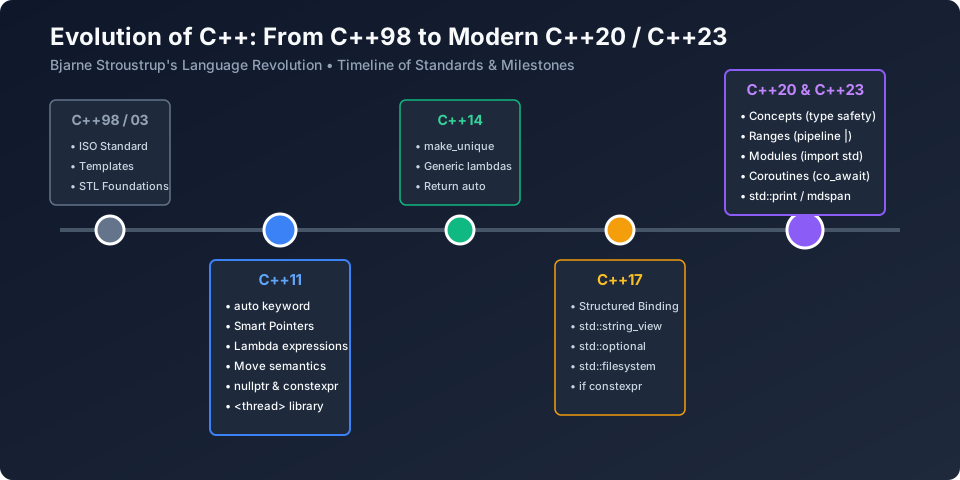
Figure 14: Modern C++ Evolution Timeline & Key Standard Capabilities
1. std::optional<T> (C++17)
#include <iostream>
#include <optional>
#include <string>

// Returns an optional value: Either a valid string or empty (std::nullopt)
std::optional<std::string> findUserById(int id) {
    if (id == 101) return "Veewom Admin";
    return std::nullopt; // No user found
}

int main() {
    auto user = findUserById(101);
    if (user.has_value()) {
        std::cout << "Found: " << user.value() << "\n";
    }

    // Default fallback value using value_or():
    std::cout << "Result: " << findUserById(999).value_or("Guest User") << "\n";
    return 0;
}
2. std::filesystem (C++17)
#include <iostream>
#include <filesystem>

namespace fs = std::filesystem;

int main() {
    fs::path myDir = "test_folder";
    if (!fs::exists(myDir)) {
        fs::create_directory(myDir);
        std::cout << "Created directory: " << myDir << "\n";
    }
    return 0;
}
Frequently Asked Questions (FAQ) - Student & Interview Review
Q1. What is std::optional introduced in C++17?
std::optional represents a value that may or may not be present, safely replacing dangerous null pointers and sentinel error codes (-1). Accessing an empty optional via .value() throws std::bad_optional_access.
Q2. What are Structured Bindings in C++17?
Structured bindings allow you to unpack tuples, pairs, structs, and arrays into separate distinct variables in a single clean declaration: 'auto [id, name, score] = getStudent();'.
Explore Related C++ Tutorials & Next Steps
Boost your C++ proficiency by studying these closely connected core modules:
Lambda Expressions
Anonymous functions and closure captures.
Concepts & Ranges
C++20 type constraints and functional pipelines.
Smart Pointers
Automatic memory safety with unique_ptr and shared_ptr.


You may also like this!
© Veewom.com. | Managed by PinePL
